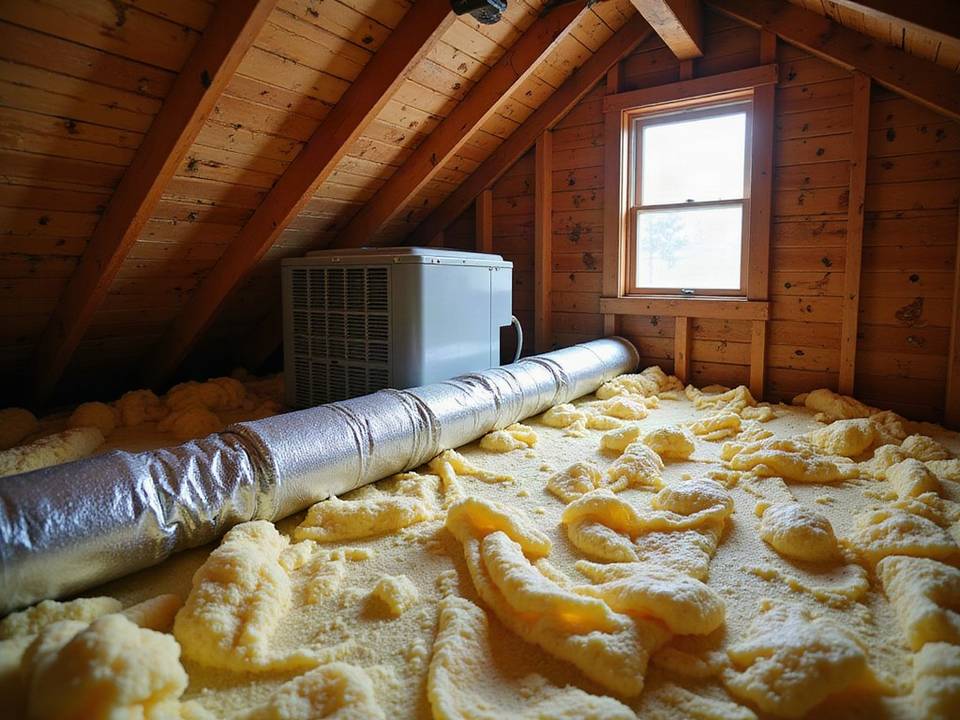
San Angelo sits in climate zone 3B, the dry version of the warm southern zone, along with the rest of Tom Green County and neighboring Runnels and Irion counties. For zone 3, ENERGY STAR’s recommended levels for existing homes are R-49 for an attic with no insulation and R-38 added on top of an attic that already has 3 to 4 inches. A floor over unheated space is listed at R-19.
Those are the targets. The rest of this guide explains what they look like in your attic, how to check where you stand, and why the Concho Valley sun makes reaching them worth the effort.
What the R numbers really mean
An R-value measures how well a material resists heat moving through it. Bigger numbers resist more. The catch is that each material reaches a given R-value at its own depth, so “how many inches” depends on what is being installed.
- Loose fill fiberglass needs the most depth to reach a target.
- Loose fill cellulose is denser and gets there with fewer inches.
- Batts come labeled with their R-value, but only perform as labeled when they fill the cavity without gaps or crushing.
- Spray foam is usually applied to the underside of the roof deck rather than the attic floor, which changes the whole approach.
Every bag of loose fill carries a coverage chart from the manufacturer. It lists the settled thickness needed for each R-value. Ask your installer to follow that chart and to leave depth rulers stapled to the trusses so you can see the result later.
Why West Texas attics work so hard
San Angelo gets a lot of sun and very little cloud cover to soften it. On a summer afternoon, shingles and roof decking soak up that heat and pass it into the attic, where temperatures can climb far above the air outside. Whatever sits on your attic floor is the only thing standing between that heat and your ceiling drywall.
When the layer is thin, the ceiling warms up and keeps radiating heat into the rooms below long after sunset. The air conditioner runs late into the evening, and bedrooms on the west side stay warm at bedtime.
Dry air helps in one way. Nights often cool off quickly here, and a house with good attic insulation holds onto that cooler air into the next morning. A poorly insulated house loses that advantage by midday.
Winter matters too. Cold snaps and hard freezes do reach the Concho Valley, and the same thin attic that let summer heat in will let furnace heat escape. Reaching the recommended level pays off in both seasons.
How to check your own attic
- Go up early. Pick a cool morning. Bring a flashlight, gloves, a dust mask and a tape measure.
- Stay on the framing. Step only on joists, trusses or a walkway. Drywall will not support your weight.
- Look across the surface. If the tops of the ceiling joists are visible, you are short of the mark.
- Measure in several places. Check near the hatch, in the middle and out toward the eaves, where depth is often thinnest. Use the lowest reading.
- Watch for dark spots. Gray or black patches on the insulation usually mean air and dust are moving through from the house below. Those are leaks to seal.
Many older homes in established San Angelo neighborhoods still have the original thin layer, sometimes packed down to just a few inches. Rental houses near Goodfellow Air Force Base and Angelo State University often fall in the same category, because attic upgrades are easy to put off when tenants change every year or two.
Seal the leaks before adding depth
Loose fill insulation slows heat, but air passes right through it. Gaps around light fixtures, plumbing vents, wiring holes, the attic hatch and the top plates of interior walls let attic air and West Texas dust drift down into your living space. Sealing those openings first lets new insulation do the job it is rated for.
Dust storms and steady wind push fine grit into every crack, so this step matters here. A careful crew seals before it blows.
Ducts, radiant barriers and spray foam
Most San Angelo homes have ductwork running through the attic. That puts your cooled air in the hottest part of the house. Two upgrades can help.
- A radiant barrier reflects heat from the roof deck before it reaches the attic floor and ducts. Sunny, hot places like this one are where it does the most good. Our post on radiant barriers under the West Texas sun covers the details.
- Spray foam on the roof deck brings the attic and ducts inside the conditioned space. It is a bigger change and should be planned with your HVAC system in mind.
For many houses, though, the simple answer is a proper blown in attic top up after air sealing.
When the old insulation should come out
Sometimes adding more on top is the wrong move. If the existing layer is soaked from an old roof leak, full of rodent droppings, or crushed flat from storage and foot traffic, removing it first gives a clean start and a clear view of every gap that needs sealing.
What affects the cost
We do not quote numbers online, because every attic is different. The main factors are the attic’s square footage, how much is already there, whether old material has to be removed, how much air sealing is needed, how easy the attic is to reach and move around in, and the material you choose. Our insulation cost guide walks through each of these.
Quick recap
- San Angelo is in climate zone 3B.
- ENERGY STAR lists R-49 for an empty attic and R-38 added to an attic with 3 to 4 inches.
- Thin attic insulation lets roof heat radiate into your rooms well into the evening.
- Seal air leaks first, then add depth.
- Remove old insulation when it is wet, dirty or crushed.
We work on homes in San Angelo, Wall, Christoval, Grape Creek, Miles and Mertzon. Want to know how your attic measures up? Request a free attic inspection and we will check the depth, find the leaks and recommend a plan that fits your house.