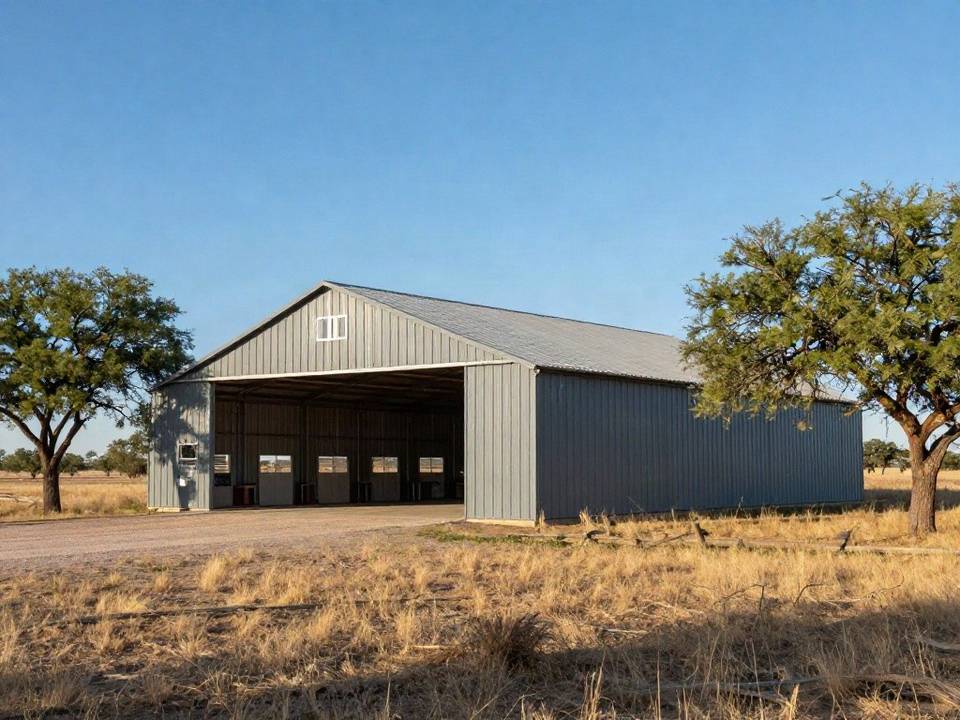
Walk into an uninsulated pole barn on a clear winter morning around San Angelo and you may feel it before you see it. Drops of water fall from the roof panels onto the truck, the tools and the hay. By afternoon the same building is hot enough to make work miserable. Both problems come from bare metal, and both have a fix.
This guide covers why pole barns sweat, which insulation methods hold up in the Concho Valley, and what to think about before you choose.
Why a metal roof drips in a dry climate
People are often surprised that a barn drips in a place as dry as West Texas. The cause is the big swing between day and night. After a cool, clear night, the metal roof gets colder than the air inside the building. Any moisture in that air, from livestock, a damp concrete slab, a propane heater, wet equipment or simply the morning air, condenses on the cold underside of the panels. Then gravity takes over.
Over time that dripping rusts fasteners and purlins, stains stored feed, and leaves puddles on the floor. Insulation stops it by keeping warm, moist air away from the cold metal, or by keeping the metal surface warm enough that water never forms.
The summer side of the problem
Under full West Texas sun, a metal roof gets very hot. With nothing under it, that heat pours straight down into the barn. Even if you never plan to cool the building, insulation and a reflective layer can make a working shop far more tolerable through a long summer, and they protect stored equipment, chemicals and feed from extreme heat.
Options that work
Closed cell spray foam. Sprayed directly onto the underside of the roof panels and walls, closed cell foam sticks to the metal, seals gaps at laps and fasteners, and stops condensation at the source because moist air can no longer reach the steel. It also adds some stiffness to the panels. It is the most complete solution and usually the most involved. Our spray foam service page explains the process.
Open cell spray foam. Lighter and softer, open cell foam insulates well and seals air, but it lets more moisture pass through. In a barn with animals or wet activities it may need a vapor retarder or coating, so it is a choice to make carefully.
Faced blanket or roll insulation. Fiberglass with a reinforced vapor retarding facing is common in new metal buildings, where it is installed between the purlins and the roof panels as the roof goes on. It works well when the facing is continuous and the seams are taped. It is hard to retrofit into an existing barn without taking panels off.
Reflective insulation and radiant barriers. A foil product with an air space next to it can cut summer heat from the roof. On its own it does little for winter condensation unless it is sealed carefully. It often works best paired with another layer. See our radiant barrier page.
Rigid board. Foam board is useful for walls, end walls and areas you want a clean, durable finish. Seams must be taped to keep moist air off the metal.
What drips: common mistakes
- Unfaced fiberglass against metal. Moist air passes through it, condenses on the steel and soaks the batts from behind.
- Torn or untaped facing. Every gap becomes a spot where water collects.
- Insulating the roof but not the walls. Condensation simply moves to the wall panels.
- Ignoring big doors and eaves. Roll up doors and open eave gaps let air pour in and around your insulation.
- Running unvented heaters in a sealed barn. Burning propane adds water vapor to the air. Ventilation still matters.
Questions to answer before you choose
- Will you heat or cool the building, or just keep it from sweating?
- Will animals, wash bays or wet equipment be inside?
- Is the building going up now, or already standing?
- Do you plan to finish the interior with liner panels or plywood later?
- Might part of it become an office, bunkhouse or living space someday?
If living space is on the table, our barndominium insulation guide goes deeper on that path.
What drives the cost
We do not post prices, because barns vary so much. Cost depends on the size of the roof and wall area, the material and thickness you choose, whether the building is new or existing, how much prep and cleanup the metal needs, access for equipment, and how far the site is from town. Our insulation cost guide covers these factors in more detail, and our metal building insulation page explains how we approach these jobs.
Rural work across the Concho Valley
Pole barns, hay barns, equipment sheds and ranch shops make up a big share of the buildings around here. We work on them in and around San Angelo and out in the surrounding country near Wall, Christoval, Grape Creek, Miles and Mertzon.
The short version
- Barns drip because cool nights chill the metal below the dew point of the air inside.
- Keeping moist air off the steel is the key to stopping it.
- Closed cell spray foam is the most complete fix for existing barns.
- Faced blanket insulation works well when installed during construction with taped seams.
- Radiant barriers help with summer heat but are not a condensation fix by themselves.
Tired of rust and dripping water in your barn or shop? Request a free estimate and we will look at the building, talk through how you use it, and recommend an insulation plan that keeps it dry and comfortable.